Why Operating Partner ROI Matters More Than Ever
Ask ten private equity professionals where returns will come from and the answer is the same: execution. Multiple expansion is harder to rely on, financing costs more, and operational improvement now sits at the centre of the investment thesis. Operating partners are no longer brought in for isolated problems; they’re expected to influence portfolio value creation from diligence through exit.
Many operating partners have spent weeks in commercial due diligence by the time an acquisition closes, so they know where execution is likely to stall once the 100-day value creation plan begins. The work varies by company, technology, finance, pricing, operating model, but the expectation stays the same: execute faster, build a stronger business.
That raises a pertinent question: how do you measure Operating Partner ROI? EBITDA growth is usually the first place people look, but it’s incomplete. A portfolio company’s results reflect hundreds of decisions by executives, board members, investors, and market forces over several years; an operating partner influences many without owning all of them. Judging Operating Partner ROI on financial outcomes alone misses most of the contribution that created them.
Measuring contribution instead of attribution
Value creation is shared across the investment team, management, functional leaders, external advisers, and the operating partner. Isolating one person’s contribution usually produces a number that looks precise but rests on assumptions. A better starting point is the work itself, which needs a reference point before any programme begins.
- What was the company’s financial performance?
- How mature were its reporting processes?
- Which operational issues were already known?
- Where were management teams spending their time?
Without those answers, almost any improvement can be explained away as market momentum or organic growth. The same discipline applies to transformation initiatives: expectations for pricing, procurement, commercial improvement, or technology modernisation should exist before the work starts, not after, since hindsight creates bias. The contribution changes deal to deal challenging assumptions during diligence on one, months with a struggling management team on another. Some are visible, a major transformation programme; others are quieter, better governance, cleaner reporting, tighter focus. Those contributions rarely show up as a line in EBITDA, yet deal teams notice the difference.
Operating Partner ROI resists a single number. The evidence sits in execution quality: projects finish closer to schedule, decisions rely on better information, governance is more consistent, and problems get solved earlier instead of late. Financial performance eventually reflects those changes, but it’s the outcome, not the starting point, of measurement.
A contribution-based approach gives investment committees a more realistic view of Operating Partner ROI, spread across many decisions rather than one person’s result.
The Operating Partner Metrics That Matter
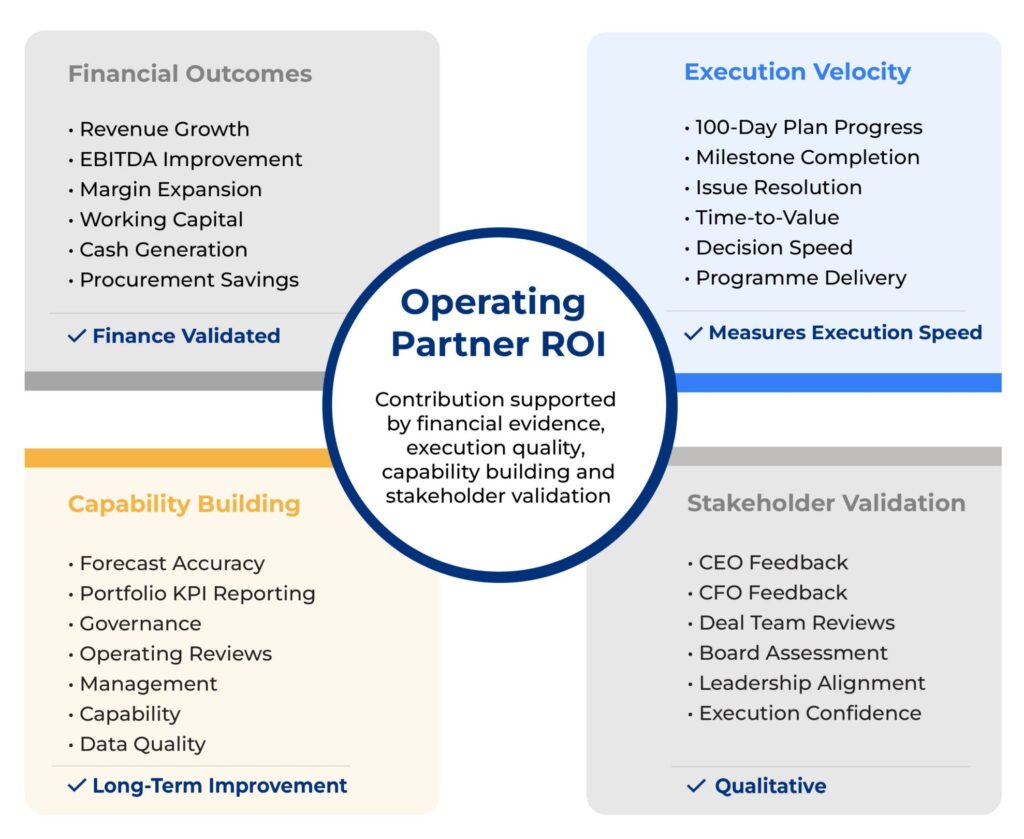
A more useful view weighs several forms of evidence together: financial results matter, but they’re only part of the story.
Financial outcomes
Any discussion of Operating Partner ROI comes back to business performance, but the numbers need context: revenue growth, EBITDA improvement, margin expansion, working capital, cash generation, and procurement savings reflect management execution and market conditions as much as any one person’s call. Operating partners influence many outcomes, but the numbers belong to the business.
The practical approach: connect each financial outcome to the initiative that produced it and have finance validate it, creating a record of what changed without a credit debate.
Execution velocity
A delayed pricing review, a slipping technology programme, or governance meetings that drift for months all carry a cost, since every quarter affects value at exit. When an operating partner removes blockers, keeps the 100-day value creation plan on track, or shortens the gap between planning and execution, results show up earlier and compound over the hold period. It rarely appears as a line item, but deal teams recognise it.
Capability building
A company that forecasts accurately, produces reliable KPI reporting, makes faster decisions, and runs consistent operating reviews is in a stronger position than before. Those habits don’t disappear once the operating partner steps back; they become how management runs the business.
Stakeholder validation
Numbers explain what happened. People explain how it happened. A CEO can describe whether priorities got clearer, a CFO whether reporting became more reliable, deal teams whether decisions happened faster, and board members often notice governance changes before they show up in financial reports.
Those conversations don’t replace quantitative measures but combined with financial evidence they give firms a fairer picture of Operating Partner ROI than any single metric.
Building an Operating Partner Scorecard Framework
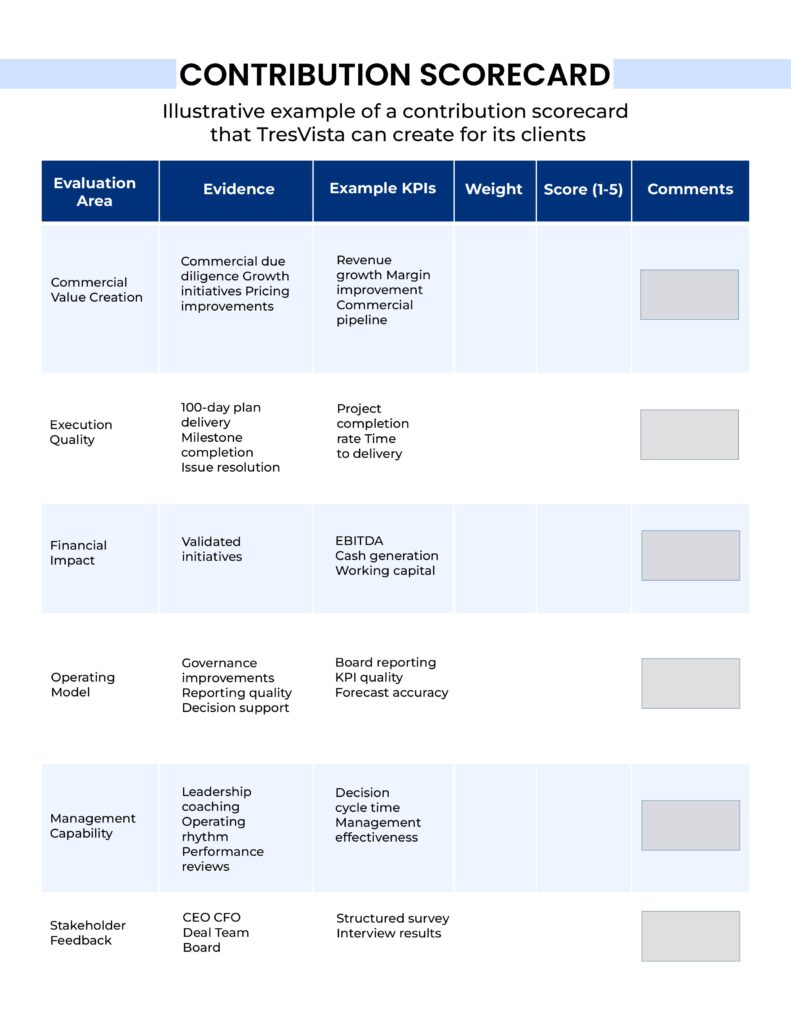
Every firm assesses Operating Partner ROI differently, and consistency is often missing: one company measured one way, the next judged another way. An Operating Partner Scorecard Framework gives firms a common standard.
The work starts before any initiative begins: capture the company’s financial position, reporting quality, operating processes, and governance. That baseline matters because memories fade while numbers remain.
Each initiative should link clearly to the value creation plan, with the expected outcome, timeline, and evidence required agreed early. Waiting until the end to decide what “good” looks like leads to debates, not answers.
Financial impact deserves independent validation but results rarely tell the whole story: shortened decision cycles, better reporting, or governance changes often precede EBITDA improvement, and those belong in the scorecard because they explain why the numbers moved later.
The framework also keeps firms out of endless credit disputes. On a pricing programme, the operating partner shapes the approach, management executes it, finance confirms the numbers, and the deal team challenges assumptions, recording each contribution rather than dividing one outcome into arbitrary percentages.
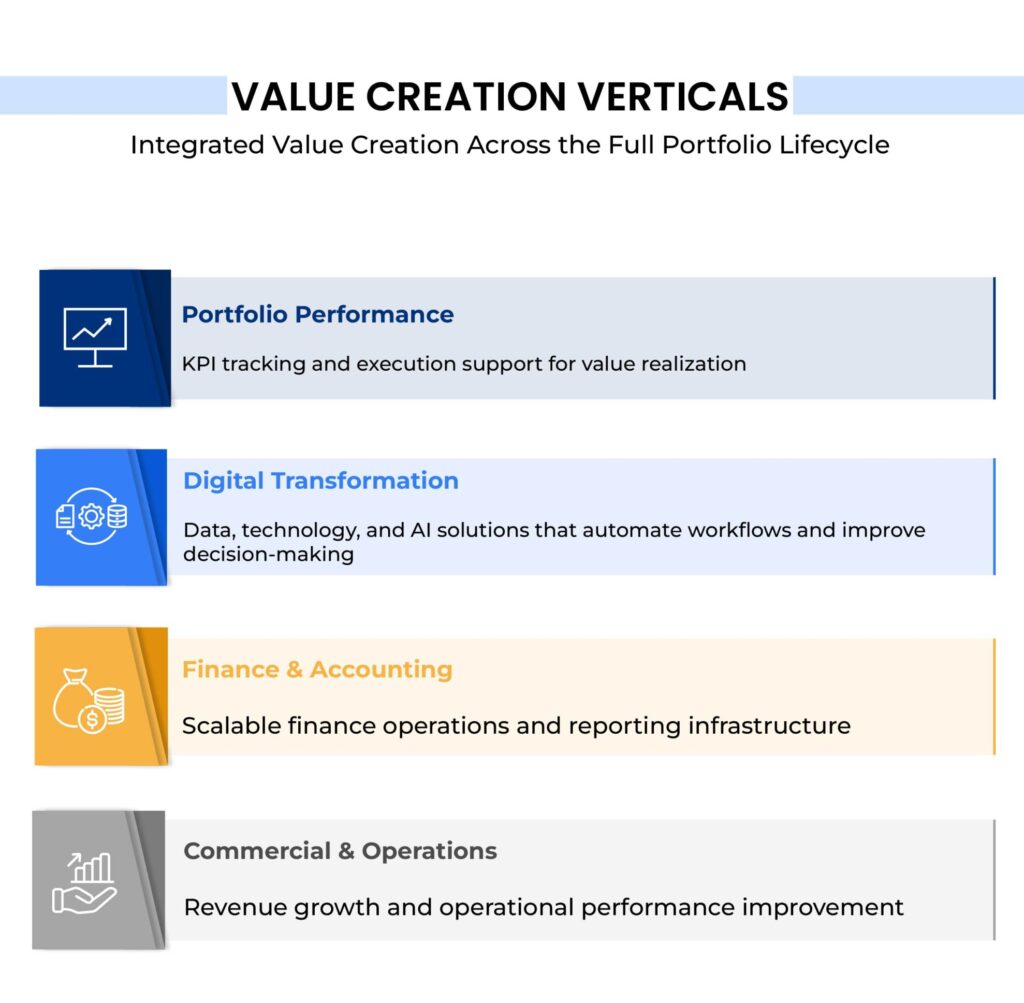
Operational value creation generates a constant flow of information. Every portfolio company reports differently, initiatives move at different speeds, and progress gets tracked across spreadsheets, emails, and management packs, so it often reaches the operating team stale or hard to compare.
TresVista’s portfolio value creation solution gives operating partners and deal teams one place to monitor initiatives instead of assembling information from multiple reports, with a single reporting environment for KPI reporting and value creation initiatives. Deal teams can review progress consistently, flag issues earlier, and see whether execution is keeping pace with plan.
Rethinking Operating Partner ROI
Private equity firms increasingly compete on execution, not only on deal selection. That makes measuring Operating Partner ROI more important than it was a decade ago.
The objective is straightforward. Build a system that explains what changed, what evidence supports it, and where the operating partner influenced the outcome. Firms that can answer those questions consistently will learn faster across their portfolios and make better decisions on future investments.