Give the same AI tool to five teams inside the same company and you’ll get five different outcomes. One team saves hours a week. Another can’t get a straight answer out of it and quietly stops using it. The model is identical in both cases, so the model isn’t the explanation.
We see this pattern often across various engagements. Clients arrive expecting the decision in front of them to be which model to license, or whether a competitor has already moved. Those questions matter eventually, but they rarely explain why a project stalls. The real enterprise AI integration challenges show up underneath the model: whether the data it needs to touch is findable, structured, connected, and governed. Get that wrong, and the best model available will produce answers that sound confident and have nothing to do with the business.
Three problems, not one
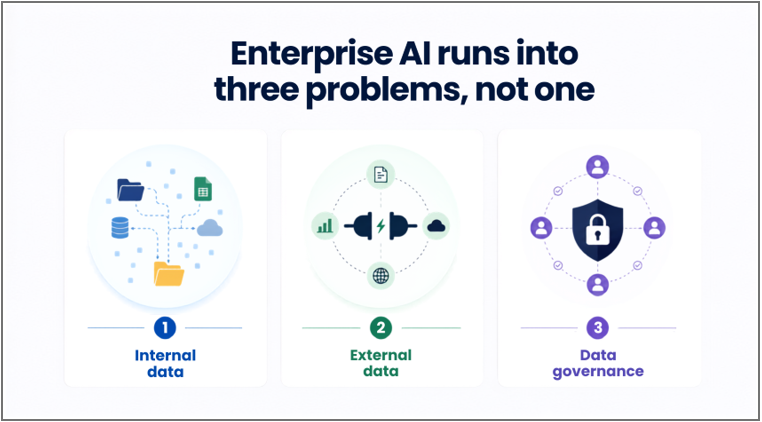
AI data integration usually gets treated as a single problem, which is part of why it’s hard to fix. In practice it’s three separate problems, and they need three separate answers.
Internal data is the most familiar one and the messiest. A company’s real data footprint rarely matches its org chart. Customer records sit in a CRM. Financials sit in an ERP. Deal notes and reporting live across SharePoint, shared drives, and an Excel model someone built three years ago that nobody has touched since, but everyone still relies on. Each one uses its own naming conventions, its own field structures, its own update schedule. An AI system pointed at all of it at once doesn’t fail loudly. It fails quietly: an answer that reads as internally consistent but pulled from the outdated version of a field that has three names across three systems. Skip standardizing internal data before deploying AI, and the inconsistency doesn’t disappear. It just waits to show up inside a decision that used the wrong number.
External data is a different problem with a different fix. Enterprise AI increasingly needs to reach outside the company: vendor feeds, public filings, state or regulatory databases, third-party APIs. This is a system integration problem more than a data quality one, and more precisely, a matter of AI data pipeline integration: does the pipeline keep working when a vendor changes its API format, or a public site restructures, or a feed drops for a day. AI API integration for enterprises rarely fails on day one. It fails months in, once nobody’s watching the pipe anymore, which is exactly when the data matters most.
Data governance is the one most likely to get folded into the other two and treated as a checklist item at the end, and it deserves better than that. As AI systems get access to more of a company’s data, someone must define who can query what, what gets logged, where data can and can’t live, and how long it’s kept. For investment banking, private equity, and asset management clients, this carries extra weight: information barriers and MNPI restrictions apply to an AI system with the same force they apply to an analyst. A tool that queries across deal teams without respecting those walls isn’t a productivity win, it’s a compliance problem that hasn’t surfaced yet. Built in from the start, governance is a design constraint. Bolted on afterward, it’s a remediation project, and a more expensive one.
What the orchestration layer does
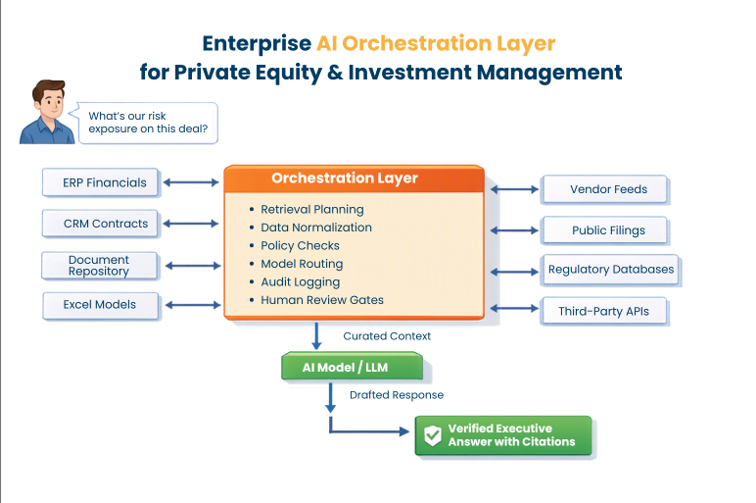
Most enterprises don’t need to replace their existing stack. The real work is integrating AI into legacy systems, not swapping them out: connecting AI with existing systems the business already depends on, rather than building around them. That connecting happens through a layer that sits between the AI model and the underlying systems, deciding where to look, how to combine what it finds, and what rules apply before an answer reaches anyone. Some vendors call this an AI orchestration platform. We call it an orchestration layer, since it’s the connective piece between systems, not a standalone product a company builds on top of.
Take a question like “what’s customer profitability for Portfolio Company X this quarter.” Answering it well means pulling revenue from an ERP, contract terms from a CRM, cost allocations from a separate reporting tool, reconciling naming differences across all three, checking that the person asking is allowed to see the answer, and only then handing a synthesized result to the model to phrase back. The model does none of that. The orchestration layer does, and the model ends up being the smallest step in the chain. Enterprises that treat the model as the whole solution get the confident, disconnected-from-reality answer. Enterprises that build the orchestration layer get the useful one.
What readiness looks like as a set of actions
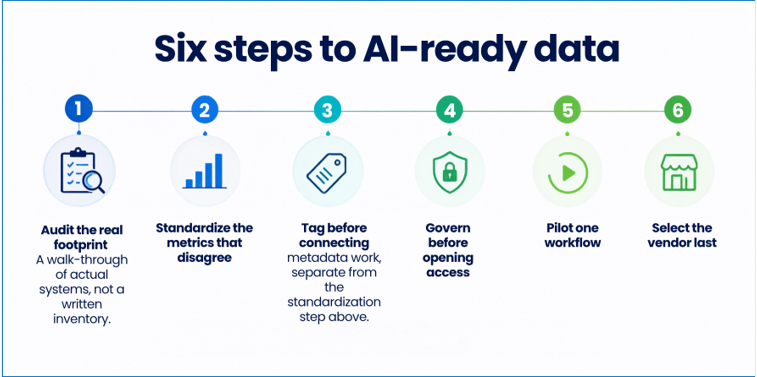
Knowing the three problems doesn’t tell a team where to start. Readiness comes down to a short sequence of concrete moves, each with an owner and an end point, done in order rather than all at once.
Audit the real footprint, not the org chart version. Send someone to walk the actual systems, not survey department heads about what they think exists. The gap between the two is usually where the tools and spreadsheets live that grew up outside official IT because someone needed something and built it. This step has a clear endpoint: a list of every system and file location that holds data an AI project would need to touch, with an owner named for each one.
Standardize a short list of metrics before touching anything else. Don’t try to reconcile every field across every system in one pass. Pick the five or six definitions that most often disagree, usually revenue recognition, customer identifiers, or deal stage, and fix those first. A narrow win here is what makes the next stage possible; a company-wide data dictionary attempted all at once tends to stall before it ships.
Build the tagging layer before connecting anything. An AI system needs to know that “customer” in the CRM and “customer” in the billing system aren’t automatically the same thing, even after the underlying data is standardized. This is metadata work, not model work, and skipping it is the most common reason a technically clean data set still produces wrong answers.
Put governance in place before query access opens, not after. Access rules, audit logging, retention policy, and, for regulated clients, information-barrier controls around MNPI, all need to exist before anyone can ask the system a question, not get retrofitted once a compliance question surfaces. Treat this as a prerequisite for going live, not a parallel workstream that can catch up later.
Pilot on one workflow before rolling out broadly. Pick a single, well-bounded process, a specific reconciliation task, a specific reporting cycle, and run the full stack against it before opening access more widely. A contained pilot surfaces the data and access problems that a design document won’t, while the cost of getting something wrong stays small.
Bring vendors in last, once the requirements are specific. By this point the team knows exactly what it needs a tool to plug into, what data it will touch, and what access rules it must respect. That’s a materially different conversation than starting from a vendor demo and hoping the fit works out.
What this looks like at scale
A recent TresVista engagement is a useful illustration. A US-based, mid-market private equity client needed a structured database of specialty pharmacies across the country. The underlying data existed, but it was scattered across state-level websites in PDFs, spreadsheets, and downloadable reports, each state formatting it differently.
The build wasn’t a single AI tool. It was a sequence: an automated extraction layer to pull raw listings off state pharmacy board sites, an AI processing step to normalize and structure the text, a classification model to sort records by category, and a senior analyst validating the output before it shipped. That combination cut the client’s manual effort by roughly 80%, based on our internal comparison against the prior manual process.
A different engagement shows the same discipline applied to a finance team’s day-to-day work. Finance teams that used to spend two full days cleaning ERP data before variance analysis now get a structured, anomaly-flagged output in hours. Schedule K-1 reconciliation that ran 25 to 30 minutes per investor now completes in under a minute, with exceptions flagged for review rather than the system claiming to catch everything on its own. Deal logging from CIMs and teasers, previously manual line-by-line extraction, is down roughly 40% in effort and keeps improving as the model learns the client’s schema. These are results from our own engagements, not third-party benchmarks.
Where to start, and how to think about vendors
The sequence that works is audit, then standardize, then govern, then select. Reversing that order, starting with a vendor comparison, is the single most common reason clients end up in our office asking why an expensive tool isn’t producing results.
At TresVista, we are an AI implementation and transformation partner, not a tool reseller, and evaluating the market is one step inside that work, not the service itself. We’ve evaluated more than 500 AI tools across client engagements. Most don’t survive a basic compliance and security screen, and of the ones that do, only a handful earn a place in active use, because they solved one specific problem well rather than claiming to do everything.
Evaluation is where a lot of vendors’ involvement stops. It’s where ours starts. The work that follows, building the data structure, the orchestration logic, and the governance controls underneath whatever tool a client picks, is what determines whether the system holds up once it’s running in production. That’s the implementation and transformation work: the client ends up with a data environment and a team that operate differently, not just a new piece of software bolted onto the old one. If you’re working through internal data fragmentation, external ingestion reliability, or the governance layer that must sit under both, that’s the conversation we’re set up to have.